

Homeless Survival Challenge
Understanding What Homelessness Does to the Body & Mind
A trauma-informed empathy exercise for donors, volunteers, and neighbors
The homeless aren’t lazy, they are warriors, their enemy is their environment or their own mind or body, and they are exhausted…
Important safety note: Do not put yourself in danger, neglect medical needs, trespass, sleep in unsafe public places, or attempt any exercise that could harm your health. These challenges are not a game. They are meant to build empathy by helping housed people notice how quickly sleep, hygiene, food, safety, and transportation affect the body.
This challenge does not pretend that a housed person can fully understand homelessness after one uncomfortable night.
It asks people to stop judging from a distance and to notice what happens when the body has no soft place to sleep, no private bathroom, no guaranteed food, no shower, no air conditioning, no reliable transportation, and no safe place to recover.
For many people experiencing homelessness, the hardest part is not just having nowhere to live. It is having nowhere to recover.
- No soft mattress.
- No private bathroom.
- No locked door.
- No safe place to sleep.
- No real rest.
And when the body cannot rest, everything else gets so much harder.
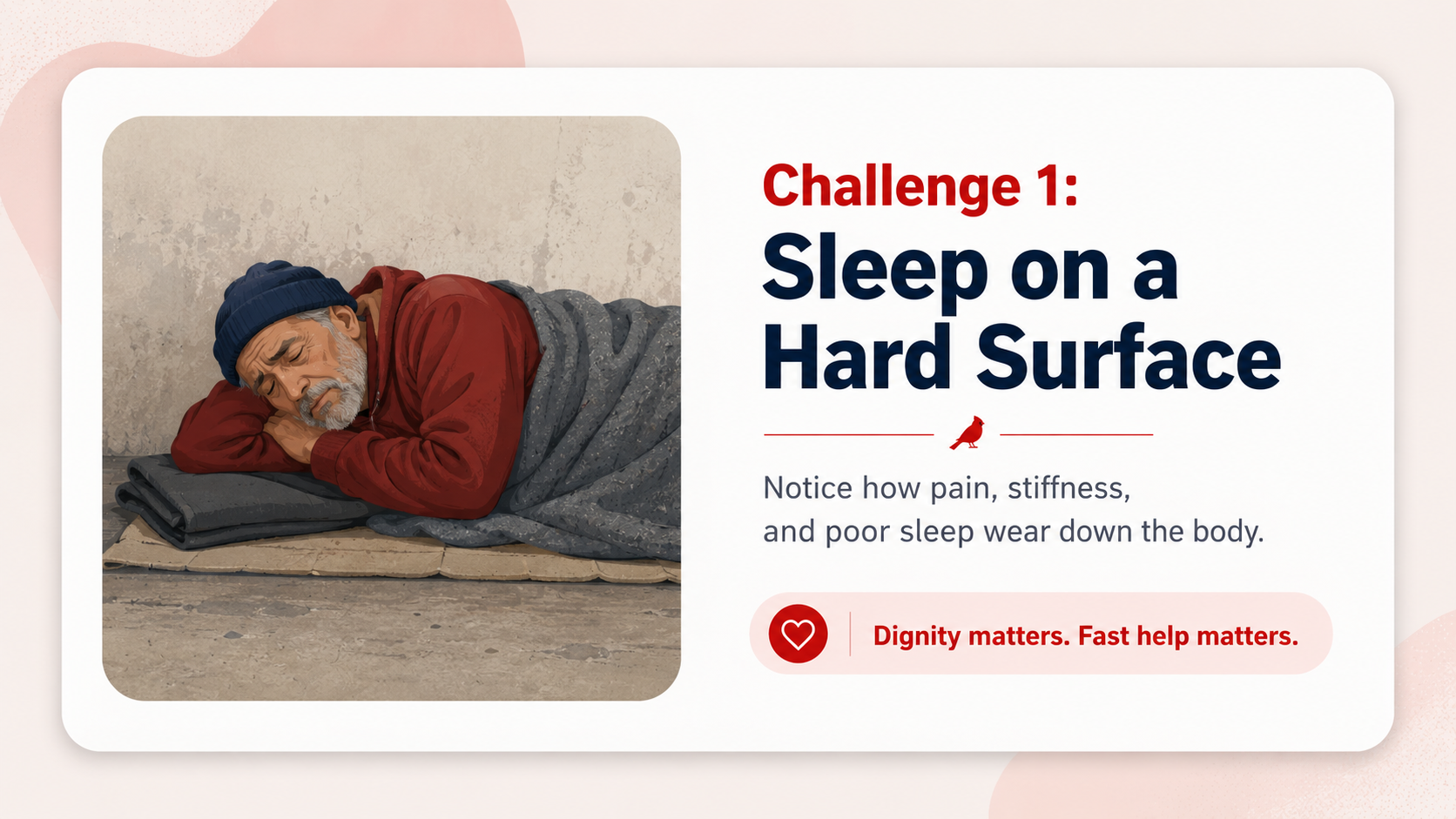
For one night, do not sleep in your bed. Sleep on a hard floor if you can do so safely. A wood floor, tile floor, or another firm surface is enough. Do not use a mattress or thick padding. Use only what someone might realistically have available, such as a thin blanket, towel, cardboard, hoodie, or sleeping bag.
Many people experiencing homelessness sleep on concrete, sidewalks, floors, rooftops, underpasses, porches, vehicles, storage units, or other hard surfaces because they have nowhere else to go. Concrete and wood do not support the body the way a bed does. They press against the hips, shoulders, spine, ribs, knees, and ankles all night long.
The next morning, write down what you notice:
- Does your back hurt?
- Do your hips, shoulders, knees, or ribs ache?
- Did your arms or legs go numb?
- Did you toss and turn because one side of your body started hurting?
- Did you wake up stiff, bruised, or sore?
- Did you sleep deeply, or did you only drift in and out?
- Are you exhausted even though you technically slept?
- Was it harder to think, work, drive, parent, or be patient?
Now imagine doing that again the next night. Then imagine doing it for a week, a month, or a year. Homelessness wears people down because the body may be running on pain, inflammation, poor sleep, and exhaustion every single day. And then imagine being someone with chronic pain problems who must withstand sharp pains all night.
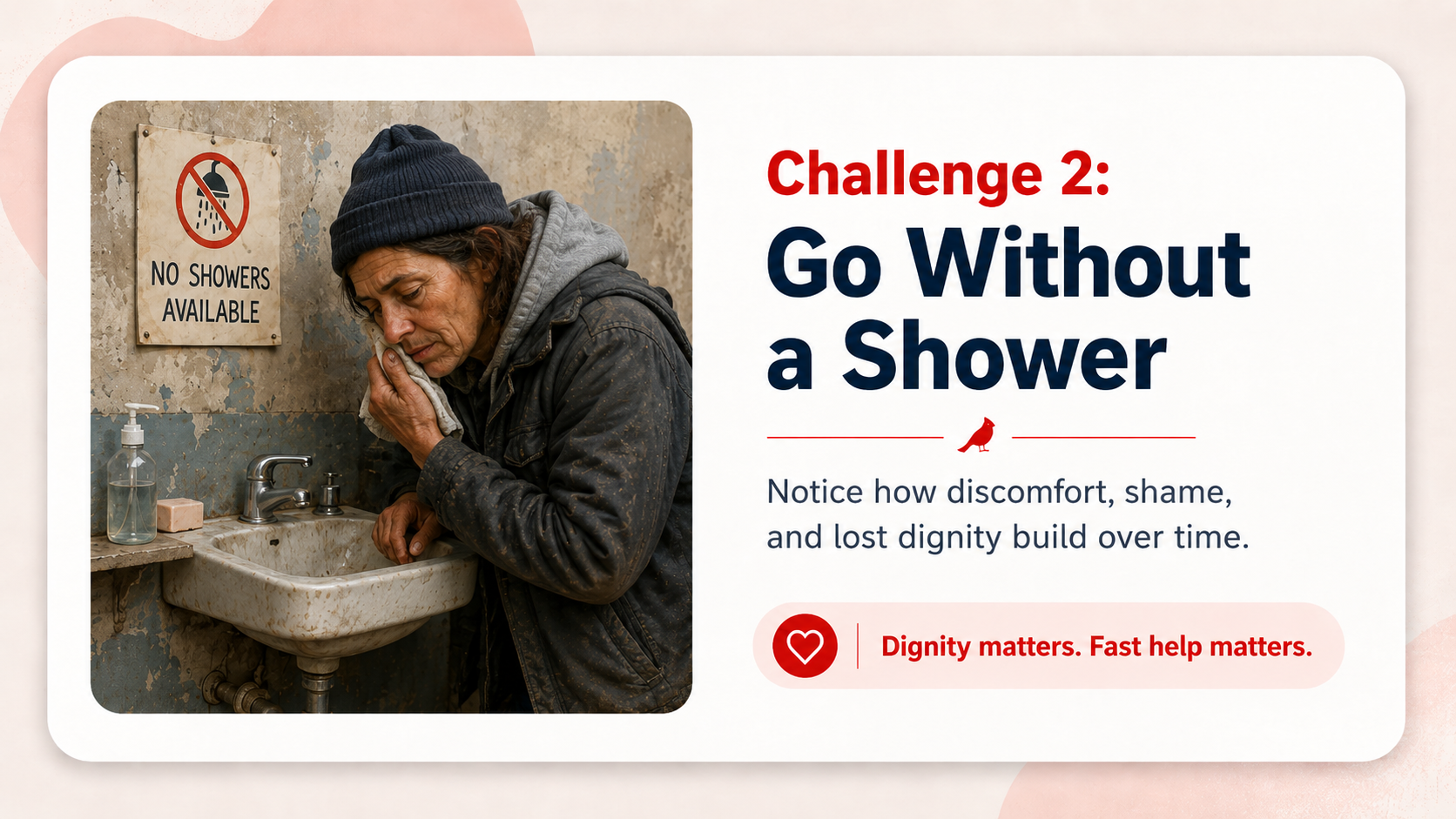
For one week, do not take a shower. Do not wash your hair in the shower. Do not use a bathtub. Wash only with a bathroom sink, soap, a rag, wipes, or whatever you can manage without access to a private bathroom.
Many people without stable housing do not have daily access to showers. Some rely on public bathrooms, gas stations, shelters, gyms, wipes, sinks, or the kindness of others. Some have to choose between food, gas, laundry, hygiene items, or transportation to a place where they can clean themselves. Imagine what it would be like to bathe yourself in a public toilet stall. Would you feel clean afterwards?
The next morning, write down what you notice:
- Does your scalp itch?
- Does your skin feel sticky, oily, sweaty, or uncomfortable?
- Do you feel embarrassed around other people?
- Do you avoid standing too close to someone?
- Do you worry people can smell you?
- Do you feel less confident or less human?
- Did it affect your mood?
- Did you start withdrawing socially?
- Did you feel like your dignity was slipping?
Now imagine trying to apply for a job, go to a doctor, sit in a waiting room, or ask for help while feeling dirty, exposed, and ashamed. Lack of hygiene is not a character flaw. It is often a lack of access. If you can’t do it for a week, do it for as long as you can. And then imagine what it would be like if you worked a manual job all day outside.
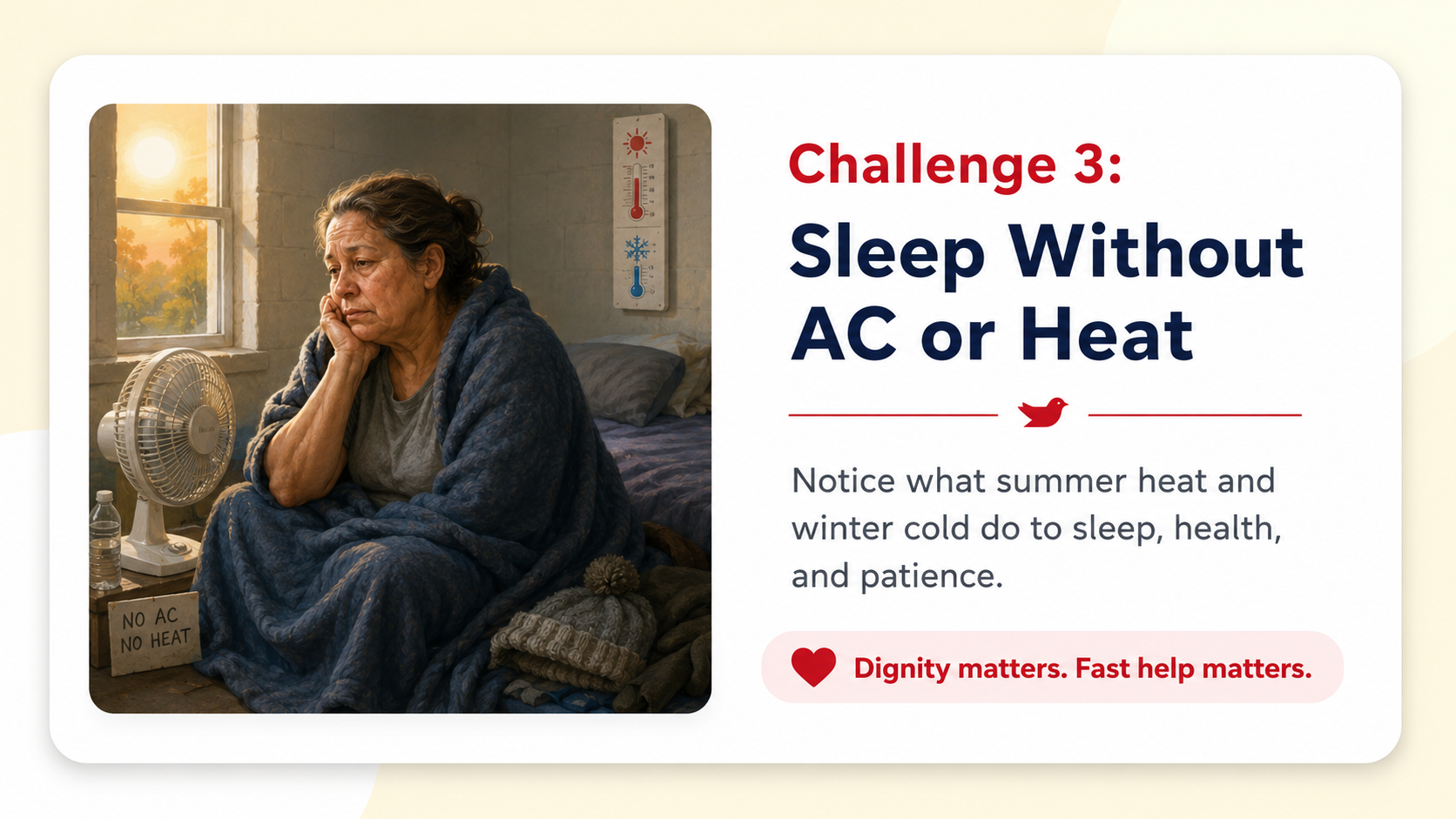
Choose a hot night. Not a comfortable spring night. A real Lowcountry hot night, where the air feels heavy and damp. Turn off the AC for the night. Open a window if it is safe. Use only a fan if needed.
Do not make this dangerous. The point is not to risk heat illness. The point is to understand what happens when the body cannot cool down enough to truly sleep. Many people sleep in tents, vehicles, sheds, storage units, abandoned spaces, or outside in extreme heat. Some are elderly, disabled, sick, or dealing with chronic pain.
The next morning, write down what you notice:
- How many times did you wake up?
- Were you sweating?
- Did your clothes or bedding feel damp?
- Did your skin feel sticky?
- Did you feel restless or trapped?
- Did your heart feel like it was working harder?
- Did you wake up thirsty?
- Did you feel foggy, irritable, weak, or exhausted?
- How much real sleep do you think you got?
Shelter is not only a roof. Shelter is also temperature control. It is the ability to cool down, warm up, sleep, breathe, and survive without the body being under constant stress. Now imagine having asthma in these conditions or being elderly.
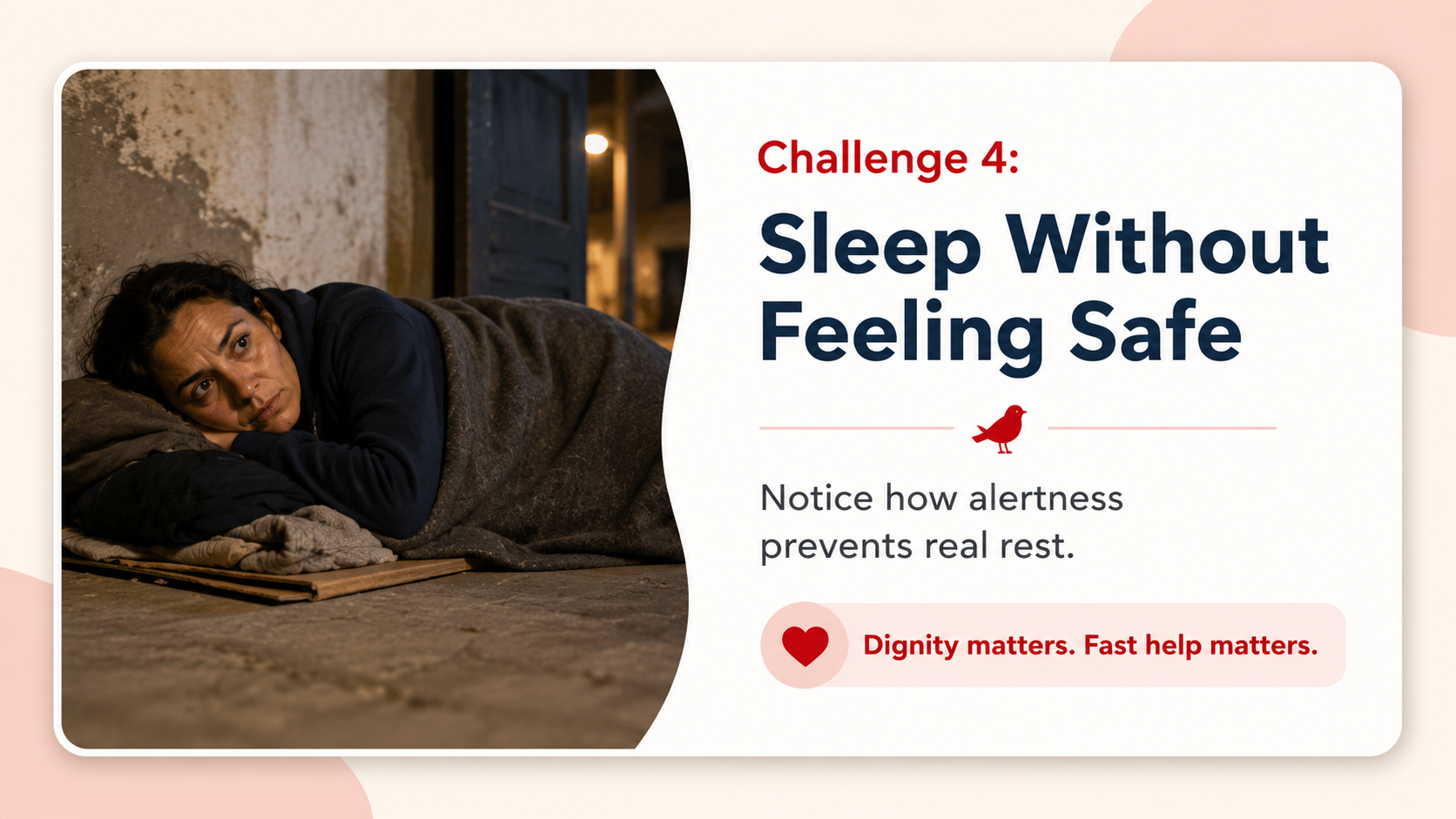
Do not put yourself in danger for this exercise. Do not sleep outside in an unsafe place, break rules, trespass, or expose yourself to harm.
Instead, choose a safe but uncomfortable place in your home, or back yard, where you would not normally sleep. A hallway. A living room floor. Near a door. Somewhere that feels less private and less protected than your bedroom.
Before you go to sleep, imagine that you do not have a locked bedroom, that someone could bother you, steal from you, judge you, or tell you to move along at any moment. Imagine trying to sleep while your nervous system stays on full alert.
The next morning, write down what you notice:
- Did you feel tense?
- Did you wake up to small sounds?
- Did your body stay alert?
- Did you feel exposed?
- Did you sleep lightly instead of deeply?
- Did your jaw, neck, back, or shoulders feel tight?
- Did you wake up tired even if you were lying down for hours?
- Did you feel anxious, irritated, or emotionally raw the next day?
For many people experiencing homelessness, sleep is not peaceful. It is interrupted by fear, noise, weather, police, strangers, theft, insects, pain, and the constant possibility of being told to leave or be arrested. Now imagine having to do this every night as a small single young woman.
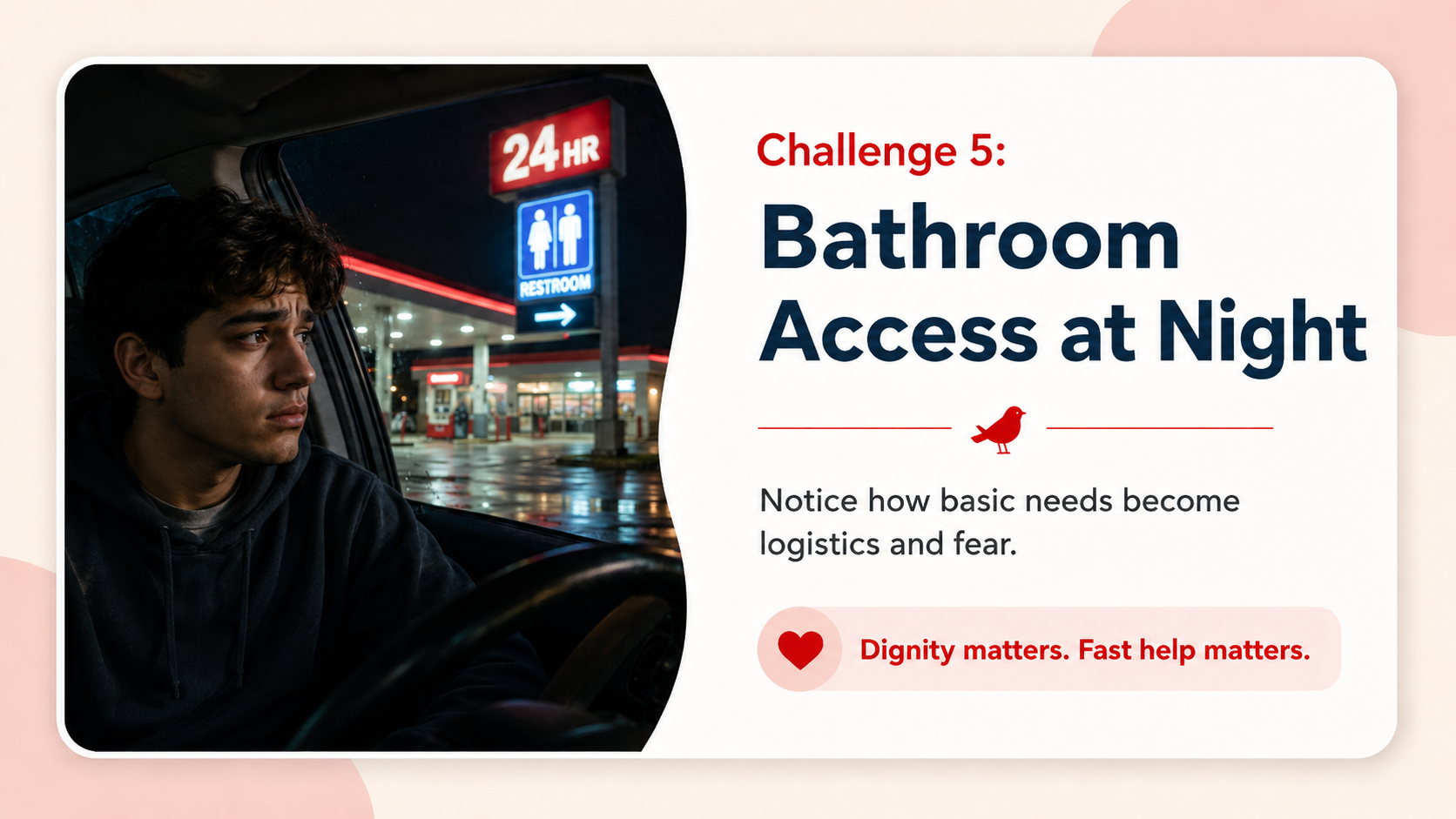
After work, do not use your bathroom at home for the rest of the evening or overnight. From the time you get home until the next morning, every time you need to use the bathroom, go to the closest gas station. It’s illegal to relive yourself or dump waste in public areas, so a functional public bathroom is your only option.
For someone living in a car, this may mean driving to a gas station, fast-food restaurant, grocery store, or anywhere else that still has an open bathroom. Late at night, most public bathrooms are closed. The only legal option may be a 24-hour gas station, and there may not be one nearby, and they may have to walk.
If they wake up at 2 AM and need to go, they cannot just walk down the hall. They may have to get dressed, put their shoes on, start the car, use gas they may not have money to replace, drive tired, hope the bathroom is open, hope the clerk allows them to use it, and hope they make it in time.
The next morning, write down what you notice:
- Did you drink less water because using the bathroom would be inconvenient?
- Did you feel anxious about needing to go?
- Did you feel trapped in your own body?
- Did the thought of leaving at night feel exhausting?
- Did it make it harder to relax?
- Did it affect your sleep?
- What if you had a stomach issue, UTI, bladder problem, diabetes, pregnancy symptoms, heavy period, mobility issue, or chronic illness?
A person living in their vehicle may be able to use the bathroom at work while they are on the clock. But work does not solve the problem of having no bathroom at night.
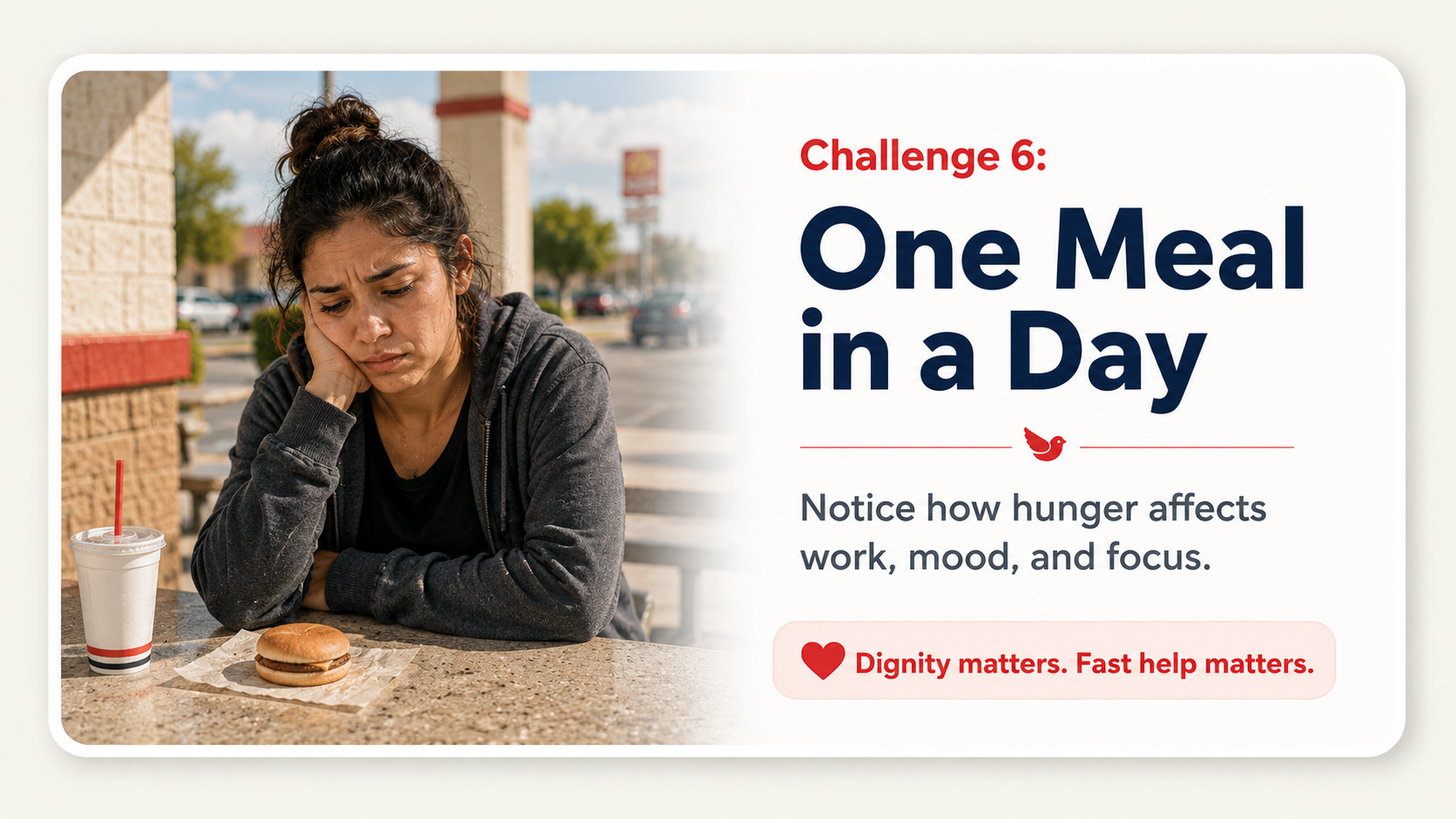
Do not starve yourself or do anything medically unsafe. If you are diabetic, pregnant, recovering from illness, have an eating disorder history, take medication with food, or have any health condition affected by fasting, do not do this challenge.
For this exercise, choose one day where you eat only one simple meal. Pick breakfast or dinner. That is your meal for the day. No snacks. No second meal. No grabbing something because you feel tired. Drink water, but pay attention to what your body feels like when it does not have enough fuel.
Many people living on the street or in vehicles do not have steady food or water access. If they have no money, they may rely on spare change, panhandling, a church meal, a food pantry, or whatever someone gives them. They may get one meal that day. They may get none.
The next morning, write down what you notice:
- Did your stomach hurt?
- Did you feel weak, shaky, irritated, anxious, or emotional?
- Did you drag through the day?
- Did you have trouble focusing?
- Did your patience get shorter?
- Did you get a headache?
- Did you sleep poorly?
- Could you have worked a full shift feeling that way?
- Could you have gone to interviews, filled out forms, made phone calls, and stayed polite?
A person who is homeless may finally get hired, but most jobs do not pay immediately. They may wait one week or two weeks for the first paycheck. If they used to panhandle to survive, morning and evening traffic may have been when they could gather enough for food. But if they are working during those hours, they may be doing exactly what society says they should do and still go hungry. Now imagine being diabetic in these conditions.
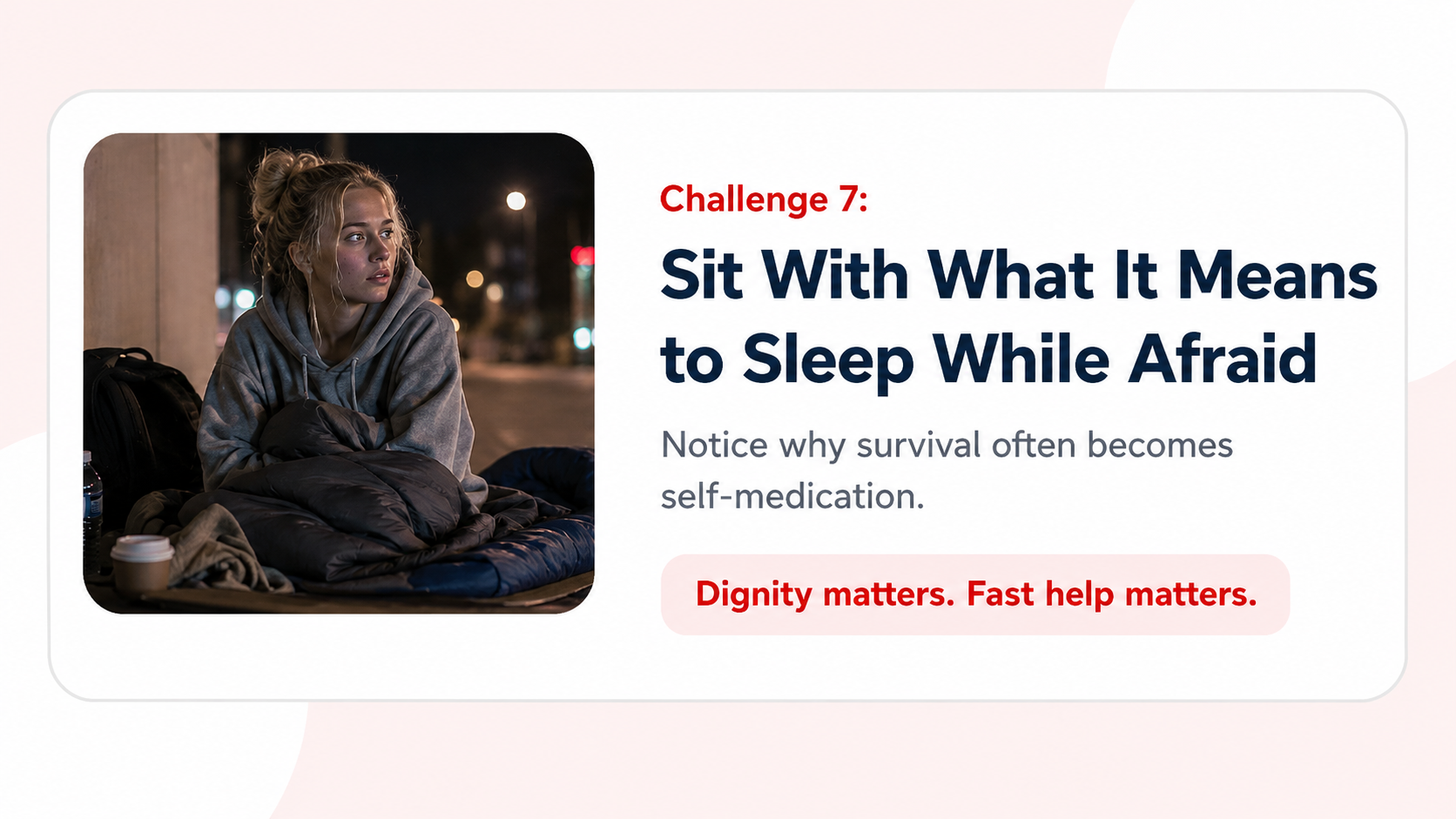
Do not put yourself in danger for this exercise. Instead, sit with this reality for a few minutes before trying to sleep: some of the worst things that can happen to a person can happen while they are living on the street. People can be threatened, robbed, sexually assaulted, attacked with a weapon, or assaulted so badly that they need a hospital.
These are not abstract fears. For many people experiencing homelessness, these are real things that have happened to them, or to someone they know. Now imagine that something traumatic happened to you, and afterward, you had no safe bedroom to return to. No locked door. No private space. No quiet room. No place where your body could finally believe, It is over. I am safe now.
Instead, you have to sleep in the same kind of environment where it happened, knowing it could happen again, at any moment. Try to imagine what that does to the nervous system.
The next morning, write down what you notice:
- Could you fall asleep?
- Would your body let you relax?
- Would every sound wake you?
- Would footsteps make your heart race?
- Would you sleep lightly, if at all?
- Would panic sit in your chest?
- Would you become irritable, jumpy, or emotionally raw?
- Would you struggle to think clearly the next day?
For many people on the street, insomnia is not a bad habit. It is survival. After one night, two nights, or three nights without real sleep, the body becomes desperate for relief. This is one way addiction can begin, not because someone wanted to party, but because they were in pain, terrified, exhausted, and needed to sleep. Passing out is not the same as resting. A person can sleep and still wake up sore, exhausted, and unrestored.
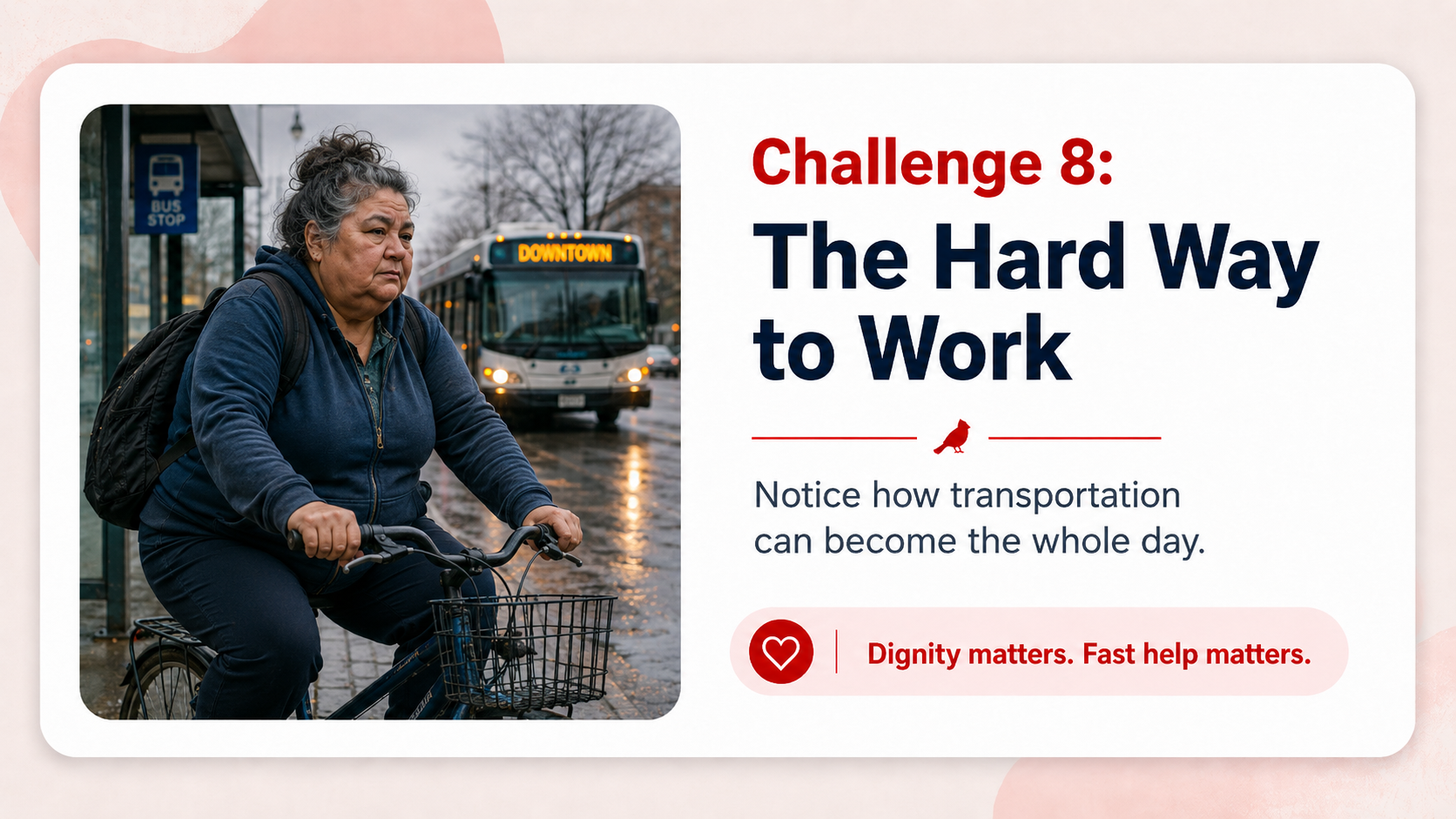
For one day, do not drive yourself to work. Take the bus. Ride a bike. Or, if your workplace is close enough to do so safely, walk.
Plan it the way someone without a car would have to plan it. Look up the bus route. Figure out the walking distance to the stop. Figure out how early you need to leave. Account for delays, weather, carrying your bag, lunch, work clothes, medications, and anything else you need.
If there is no bus route near you, imagine being the person who has no choice but to bike or walk.
The next morning, write down what you notice:
- How much earlier did you have to wake up?
- Were you already tired before work started?
- Did your feet, knees, hips, or back hurt?
- Did the weather make it harder?
- Did you sweat before you even arrived?
- Did you worry about being late?
- Did transportation take over your whole day?
- Did you have energy left after work?
- Could you do that every day while sleeping poorly and eating one meal a day?
Now imagine doing that while older, disabled, injured, sick, hungry, or in chronic pain. Imagine having arthritis in your knees and still needing to ride a bike miles to work. For people without stable housing, transportation can decide everything: work, food, medical care, shelter intake, the pharmacy, the DMV, and whether they can get back to wherever they sleep before dark. Some people are trying while carrying a level of exhaustion, pain, fear, and instability most people have never had to function through.
What This Challenge Is Really Asking
This challenge is not asking people to suffer for the sake of suffering. It is asking people to stop judging from a distance.
Homelessness is not just the absence of a house. It is the absence of recovery.
- No safe sleep.
- No private bathroom.
- No reliable food.
- No shower.
- No climate control.
- No transportation cushion.
- No place to let your guard down.
When a person is homeless, every basic human need becomes complicated. Sleeping hurts. Washing is difficult. Eating is uncertain. Using the bathroom becomes a plan. Getting to work can take hours. Staying safe becomes exhausting. Healing becomes almost impossible.
And then people wonder why someone is anxious, defensive, disorganized, addicted, drunk, depressed, exhausted, or unable to just get back on their feet.
But feet need rest. Bodies need food. Minds need safety. People need dignity.
That is why compassion matters. That is why fast help matters.
Now imagine doing all these challenges at once… in one day… for 5 months or more.
You can’t, unless you have lived it.
The homeless aren’t lazy, they are warriors, their enemy is their environment or their own mind or body, and they are exhausted…